You wake up flat, but one meal later you look three months pregnant, and no matter how clean your plate was, tomorrow it starts all over again.
If any of this resonates, I've sat across from thousands of women who looked at me with that same expression.
Not anger exactly. More like a quiet, exhausted disbelief.
They had done everything right and their body had still let them down, and nobody at their annual exam or routine screening had ever been able to tell them why. What I'm about to share with you most of them had never once heard.
And this might surprise you, but the answer has almost nothing to do with what you're eating and everything to do with what's living in you.
It's called SIBO, Small Intestinal Bacterial Overgrowth, and conservative estimates suggest it underlies 30 to 80 percent of chronic digestive complaints in women.
It won't show up on your standard bloodwork. Your doctor almost certainly hasn't tested for it. Yet it may be the most common hidden cause of chronic digestive suffering that no elimination diet ever seems to resolve.
Here's what's actually happening inside you.
Your small intestine is supposed to be relatively sparse when it comes to bacteria.
The large intestine is where your microbiome lives and thrives.
But when bacteria that belong downstream begin migrating upward, the results are immediate and relentless.
Every meal becomes fermented. Bacteria feed on carbohydrates before your body can absorb them, producing hydrogen and methane gas that has nowhere comfortable to go.
That's the bloat that appears within 90 minutes of eating. The distension that makes your waistband tighter by afternoon. The gurgling, the pressure, the low-grade misery that has quietly become your normal.
The methane these bacteria produce suppresses the muscle contractions that move food through your body by up to 59 percent.
This overgrowth isn't sitting passively in the wrong place. It is actively restructuring your digestive environment to keep itself alive longer.
Over time, SIBO damages the intestinal lining, increasing what many clinicians now call leaky gut. Bacterial toxins, inflammatory compounds, and partially digested food particles enter the bloodstream. Your immune system responds.
When that response becomes chronic, it stops being a reaction and starts being your baseline.
That's the fatigue a full night of sleep doesn't touch. The brain fog that clouds your thinking before you've finished your morning coffee. The metabolism that seems to have simply stopped cooperating.
I've watched women spend years addressing each of those symptoms individually.
The thyroid panels, adrenal protocols, hormone work, or elimination diets that provide temporary relief but don't fully eliminate the symptoms long-term.
The reason? The lack of identifying the root cause in which in so many cases is often gut molitity.
Your small intestine has a self-cleaning function called the Migrating Motor Complex, a wave of muscular contractions that sweeps bacteria downstream between meals, like a housekeeper moving through empty rooms. In healthy digestion, this wave activates roughly every 90 minutes during fasting.
SIBO disrupts it. The overgrowth impairs the nerve signals that trigger those contractions. Motility slows, bacteria linger and multiply, and the environment that allowed them to overgrow gets worse, not better.
That's why nothing seems to hold. The missing piece isn't another elimination protocol, it's restoring the movement that clears the problem at its source.
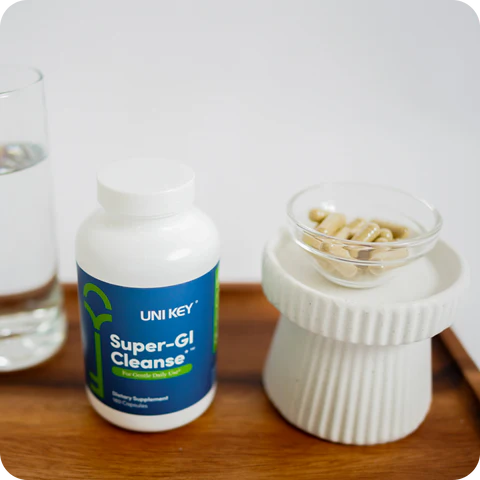
This is exactly what I designed Super-GI Cleanse to do.
Not to force the colon the way a stimulant laxative does, which irritates the intestinal lining and creates dependency over time, but to restore the rhythmic, coordinated movement your digestive tract was built to sustain on its own.