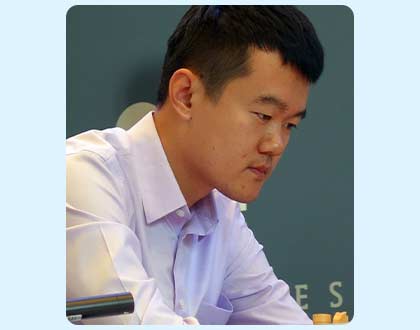
There's a press conference moment from April 2023 that I keep thinking about. Ding Liren had just drawn the first game of his World Chess Championship match against Ian Nepomniachtchi in Astana, Kazakhstan.
He sat in front of the cameras and said, quietly, that he wasn't happy and was feeling a little depressed.
He half-joked that something felt wrong with his mind and that he was flooded with emotions and memories and couldn't think about any prepared lines.
I don't think there has ever been a world chess champion who arrived at the title carrying quite that weight so openly. I think you'd agree that most champions project invincibility before a match.
Ding sat in a chair and told the truth about how he felt, then went on to become the 17th World Chess Champion and the first from China in the game's history. The score was tied 7-7, leading to rapid tiebreaks.
In the final rapid game, under immense pressure, Ding unleashed a stunning attack with Black and converted it into victory.
Ding’s Early Years
The road there was genuinely remarkable, and I want to tell you about it properly because the highlights reel doesn't do it justice.
Ding was born on October 24, 1992, in Wenzhou, a city in southeastern China with a strong chess culture, and he started playing at 4 years old.
He studied with the same coaches as women's world champion Zhu Chen.
He became the youngest Chinese national champion in history at sixteen, rated 2400.
Only four years after breaking into the top-100 at 78th place with a rating of 2664, he stormed into the top-10 with a rating of 2770. A year later, he broke the 2800 barrier (the first Chinese and the 14th player ever to do so).
From August 2017 to November 2018, he went 100 consecutive classical games without a loss — 29 wins and 71 draws against the best players alive. It was the longest unbeaten streak in history until Magnus Carlsen broke it in October 2019.
His Playing Style
His playing style has always been the opposite of dramatic. Ding's style combined rock-solid positional understanding with tactical precision.
He gave an interview to the German paper Die Tageszeitung and spoke about it directly: he had been dealing with problems sleeping, exhaustion, and depression. He said he was getting medical treatment that was helping, and he was recovering slowly.
He also talked about enjoying football and basketball, and playing table tennis with his father. When asked if he was too sensitive to be a great player, he replied simply that he tries to be a nice person.
In an interview before the 2024 World Championship in Singapore, Ding said: "It doesn't seem like I've been playing the way I used to... I don't know if I will ever reach that level again."
He went into that match against 18-year-old Gukesh Dommaraju having told the world he was just trying to limit the damage.
He still won two games and pushed a teenage prodigy to the final game before losing the title.
Honestly, I think Ding Liren is one of the most genuinely human figures the chess world has produced in a long time. Tough at the board, he is modest and soft-spoken in real life, a trait that has won fans' hearts.