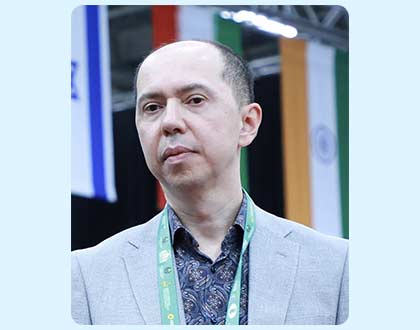
Did you know Rustam Kasimdzhanov had to win seven consecutive knockout matches to become World Champion in 2004?
128 players.
Lose one match, you’re out.
An Epic Performance
No second chances, no long matches to recover from. You win seven times in a row, or you go home.
And he kept getting through.
That means at least eighteen classical games, and often more when matches didn’t resolve cleanly and spilled into rapid tiebreaks.
Every round resets the stakes completely, and every opponent only needs one bad stretch to end your tournament.
The early rounds followed expectations. He was higher rated than his first opponents and advanced without drawing much attention.
From the third round onward, every match demanded a different level of precision. The opponents were stronger, the preparation was sharper, and the positions stopped offering easy decisions.
You were playing to avoid a single mistake that could end everything immediately.
If you go through those games carefully, what stands out is not dominance in the usual sense. He did not overwhelm opponents early or force winning positions from the opening.
Most games stayed balanced for a long time, and that balance is exactly what made them dangerous. When the position offers no clear advantage, the outcome depends entirely on who evaluates more accurately under pressure.
Again and again, he made the right decision in those moments.
By the time he reached the final against Michael Adams, the match carried that same tension.
Adams was known for control and technical accuracy, and the games reflected a clash of styles that never fully settled. The classical portion did not drift toward quiet draws.
The score stood at 3–3.
That meant the title would be decided in rapid tiebreaks.
He handled that shift better.
He did not try to force the position into something artificial, and he did not collapse under the pace. He stayed within the structure of the game, recognized the moments that mattered, and converted them when they appeared.
he final score moved to 4½–3½, and with that, he became FIDE World Champion.
What makes this run worth studying is not a single game or a single idea. It is the consistency of decision-making across a format that does not reward consistency. Seven rounds, different opponents, changing positions, and constant pressure. There was no point at which the tournament became comfortable, and no stage at which the difficulty dropped.
And yet, he kept finding a way through.
Later Career
That same quality explains what came after. Instead of building a career around visibility and dominance, he became one of the most trusted seconds at the highest level of chess, serving as head coach for players such as Viswanathan Anand and Fabiano Caruana during world championship preparation. That role depends on the ability to understand positions deeply and make accurate decisions when the situation offers no obvious answers.
The same skill that carried him through 2004.
When you look at that tournament from this perspective, it stops feeling like an unexpected run and starts to look like something much harder to pull off – a sustained demonstration of control in a format that gives you no room to recover.